
Published on 01/09/2026 in the Buying guide section
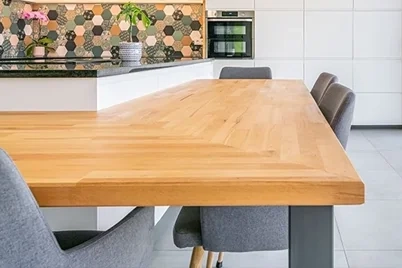
Around a table, we share meals, work and entertain guests. The tabletop is its central surface, the part we use and see every day, often for many years. It fulfils practical, aesthetic and durability requirements, all of which should be taken into account when making your choice. Opting for a custom-made wooden tabletop means working with the actual dimensions of the room and the number of guests, rather than adapting to a standard size.
This guide presents the main factors to consider before ordering a custom-made wooden tabletop: material, wood species, thickness, shape, dimensions and budget.
KEY POINTS
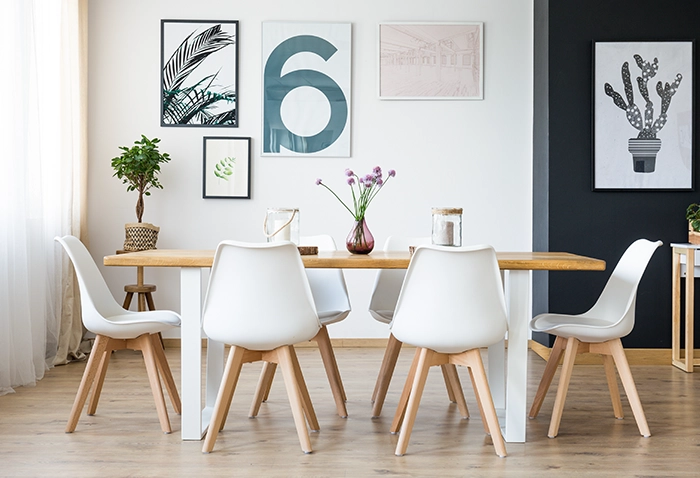
- Custom-made means the tabletop can be adapted to the dimensions of your room and the number of guests, while also being personalised through the choice of edges, corners, cut-outs and finish.
- Solid wood or laminate? Solid wood stands out for its premium appearance and its ability to be renovated by sanding, while laminate is a more economical and easy-to-maintain solution, although it cannot be repaired in the same way.
- Ilicut wood species suit a wide range of project styles: oak remains the benchmark, beech is one of the most popular choices, ash brings a contemporary touch and walnut creates a premium look.
- Tabletop thickness depends on its intended use: allow 20 to 26 mm for a desk or small table, and 30 to 40 mm for a dining table.
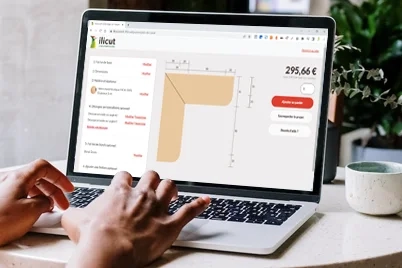
- The right dimensions ensure everyday comfort: allow approximately 60 cm per guest and 80 to 90 cm of clearance around the table. The price is then calculated instantly in the configurator.
Why choose a custom-made wooden tabletop?
Custom-made tabletops meet several needs: adapting the tabletop to the room and the number of guests, personalising every detail and achieving a more refined result than with a standard model. Here are the practical benefits of each.
A tabletop tailored to your space
The first advantage of a custom-made tabletop is that it makes the best possible use of the available space. In a small room, just a few carefully allocated centimetres can make circulation much more comfortable. A tabletop cut to the correct dimensions fits naturally into the space without compromise, whereas a standard model may create awkward or unbalanced gaps.
A tabletop adapted to your needs and lifestyle
Customisation also makes it possible to adjust the length of the tabletop according to the number of people you want to seat, without being restricted to standard dimensions. By allowing approximately 60 cm per guest, you can determine dimensions suited to your needs. The calculation method is explained in detail below.
Complete freedom of customisation
Beyond dimensions, customisation applies to every detail: the wood species and its colour, the edge profile (straight, rounded or bevelled), the shape of the corners, any cut-outs and the type of finish. The choice of edges, for example, can significantly change the appearance of the tabletop: a straight edge gives a clean, contemporary look, while a rounded edge softens the overall appearance and reduces sharp corners, which can be useful with young children. Cut-outs can be used to integrate a cable opening into a tabletop that also serves as a desk, or to attach a table base neatly. You can therefore create a tabletop that corresponds exactly to your furniture and the way you use it, without being limited to catalogue options.
A better result than a standard tabletop
A tabletop manufactured to the exact dimensions reduces the amount of cutting required on site, which is often a source of imperfections and unprotected edges. The result is cleaner, the edges are finished and treated in the workshop, and the tabletop enhances the furniture it is paired with. With solid wood, this quality of workmanship is immediately visible on both the surface and the edges, unlike a tabletop cut down on site, which may leave unfinished edges. It also saves time during installation, as the tabletop arrives ready to fit.
Solid wood or laminate panels: what is the difference?
These two product families meet different needs. Solid wood focuses on appearance and longevity, while laminate is more budget-friendly and easy to maintain. The table below summarises the differences before explaining when to choose one over the other.
| Criteria | Solid wood | Laminate panel |
| Appearance | Authentic, natural grain | Choice of decors |
| Durability | Very high | Good |
| Repair | Can be sanded and renovated | Limited |
| Price | Higher | More affordable |
| Recommended use | Main table, dining room | Desk, intensive use on a controlled budget |
When should you choose solid wood?
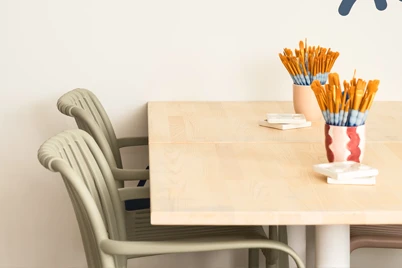
Solid wood is particularly well suited to projects designed to last, often ten to twenty years or more. It is also the preferred choice for a premium appearance, with unique grain patterns on every piece and a timeless look. Its decisive advantage is that it can be renovated: sanding followed by a new finish removes signs of wear and restores the tabletop to its original appearance. For a dining table or island, it is the benchmark solution.
When should you choose a laminate panel?
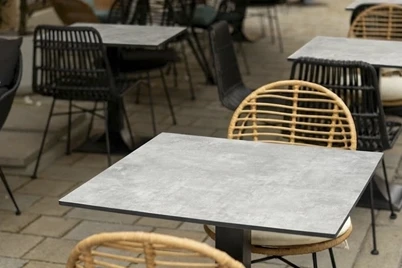
Laminate is suitable for a tight budget, intensive professional use where the tabletop will be heavily used, or situations where maintenance needs to be kept to a minimum. Its waterproof surface can be wiped clean with a sponge and requires no finish. On the other hand, deep damage cannot be repaired in the same way as solid wood.
Which wood species should you choose?
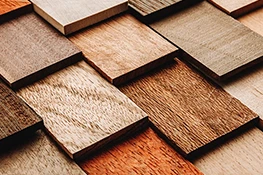
The wood species determines the style, resistance and budget of the tabletop. The four species below are part of the Ilicut range and are particularly well suited to tabletops; if you are unsure, you can order samples to compare the colours in real-life conditions.
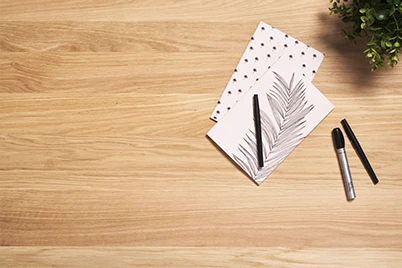
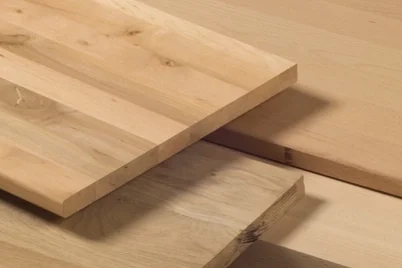
Timeless, oak remains a safe choice for a dining table: robust and durable, it withstands knocks and everyday use with ease. It is one of the best all-round choices for a custom-made dining tabletop.
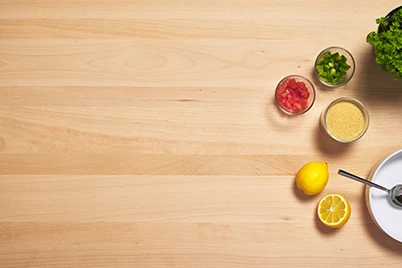
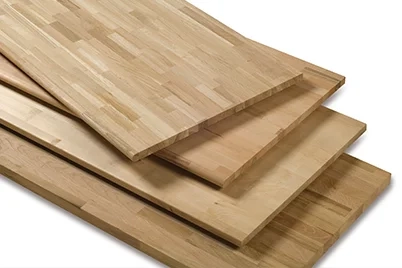
Beech, which is more affordable and lighter in colour, is just as suitable as oak for all types of tables, including everyday dining tables. It is one of the most popular wood species for tabletops. Its light, even colour is particularly well suited to clean, minimalist interiors.
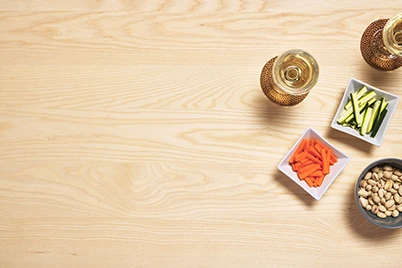
Ash, with its light colour and distinctive grain, offers good mechanical strength for a contemporary style and is a credible alternative to oak when a brighter tone is desired.
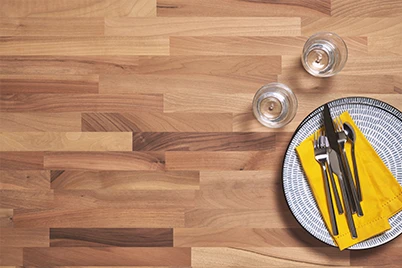
Walnut, finally, is a premium wood species with a deep, dark colour, intended for projects where the budget allows and a high-end look is desired; its dark shade works particularly well in contemporary or cosy interiors.
```
| Wood species | Style | Resistance | Budget |
| Oak | Timeless | ★★★★★ | €€€ |
| Beech | Modern | ★★★★☆ | €€ |
| Ash | Contemporary | ★★★★★ | €€€ |
| Walnut | High-end | ★★★★★ | €€€€ |
GOOD TO KNOW
Most of the wood species offered by Ilicut are PEFC or FSC certified. These certifications guarantee that the wood used comes from responsibly managed forests, according to demanding criteria relating to environmental protection, social responsibility and economic viability.
What thickness should you choose for a tabletop?
The thickness affects both the strength and appearance of the tabletop. It should be chosen according to its intended use and, above all, the distance between the support points. Here are the most common values.
| Thickness | Use |
| 20 to 26 mm | Desk, small table |
| 30 to 40 mm | Dining table (recommended) |
A simple rule to remember
The greater the span between the legs, the thicker or more reinforced the tabletop needs to be; otherwise, it may begin to sag in the centre over time.
For example, a 220 × 100 cm oak tabletop will be significantly more stable at 40 mm thick than at 26 mm. The loads placed on it also matter: a dining table regularly supports concentrated loads, such as someone leaning on it or heavy objects, which can increase bending in a tabletop that is too thin. There are two possible solutions: increase the thickness, or retain a moderate thickness while bringing the support points closer together or adding a crossbar beneath the tabletop.
For a dining table of standard dimensions, a thickness of 30 to 40 mm is generally sufficient.
What tabletop shape should you choose?
The shape depends on the available space, the number of guests and the atmosphere you want to create. Four main shapes cover most projects.
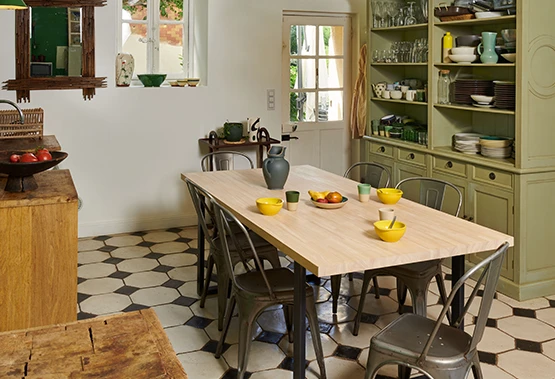
Rectangular tabletop
This is the most versatile shape, accommodating four to ten people depending on the length of the tabletop. It fits easily into long rooms and provides a practical solution when positioned against a wall. For a more contemporary touch, the corners can be slightly rounded.
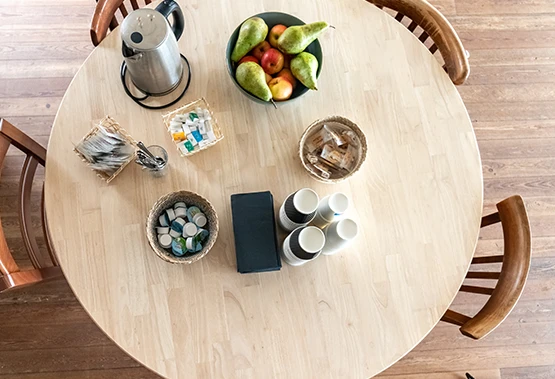
Round tabletop
A round tabletop encourages more convivial conversation because everyone is equally distant from one another. It is particularly suitable for small spaces, where it makes it easier to move around. However, beyond six to eight guests, the required diameter can become cumbersome.
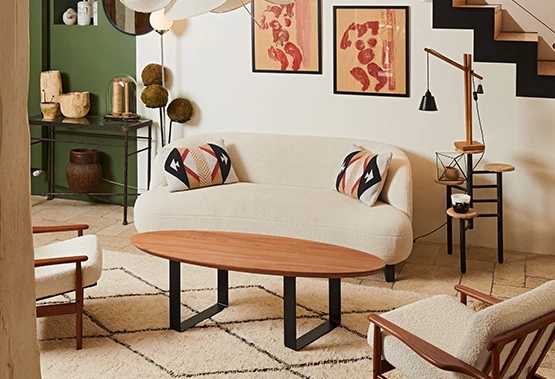
Oval tabletop
An oval tabletop offers a compromise between the easy circulation of a round tabletop and the seating capacity of a rectangular one. Its softer edges reduce protruding corners, which is an advantage in narrow passageways or homes with young children.
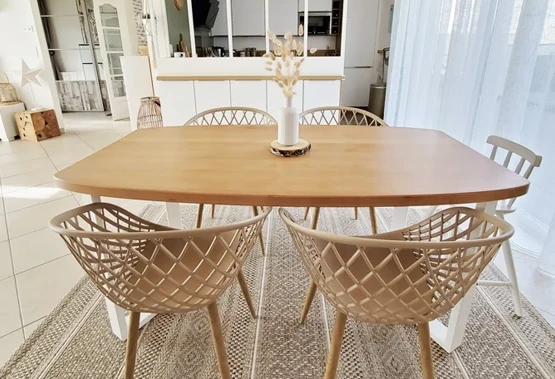
Custom shape
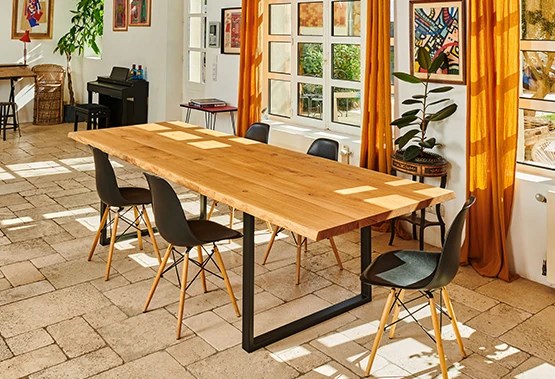
For a design-led project or a specific architectural constraint, a custom shape is possible: live-edge tabletop, bespoke cut-out, cut-outs around existing elements, cable openings, etc. Numerous options are available in the Ilicut configurator to customise the shape of your tabletop. For highly specific requirements, you can also contact the design office to request a quote.
Capacity according to shape and dimensions
| Number of people | Rectangular | Round |
| 4 | 120 x 80 cm | Ø 90 cm |
| 6 | 160 x 90 cm | Ø 120 cm |
| 8 | 200 x 100 cm | Ø 140 cm |
| 10 | 260 x 100 cm | Ø 160 cm |
These dimensions correspond to Ilicut's recommendations; they may vary depending on the layout of the room.
How do you calculate the dimensions of your tabletop?
The right dimensions can be determined in three steps: measure the room, count the number of guests, then use these figures to calculate the tabletop dimensions. Here is the method.
Step 1: Measure the available space
First measure the dimensions of the room, then allow 80 to 90 cm of clearance all around the table. This is the space required to pull back a chair and move comfortably behind someone who is seated. This clearance determines the maximum size of the tabletop. For example, in a room 3.5 m wide, once the clearance on both sides has been taken into account, the table cannot be more than approximately 1.7 m wide.
Step 2: Determine the number of guests
Allow approximately 60 cm of width per person along each side of the table. This gives everyone enough space for their place setting and elbows. Add together the guests planned for each side to determine the total length required.
Step 3: Apply the formula
To calculate the ideal length, allow approximately 60 cm per guest. A dining table is generally between 80 and 100 cm wide. For example, for eight people, 8 × 60 = 480 cm of total seating length, with four guests along the sides and two at the ends of the table; a tabletop of approximately 200 × 100 cm is therefore ideal. For six people, the same calculation gives 360 cm of total seating length, with two people on each side and two at the ends of the table, making a tabletop of approximately 160 × 90 cm suitable. These values should be used as guidelines: if you regularly entertain more people than usual, it is better to choose the next size up.
What budget should you allow for a custom-made wooden tabletop?
The price of a custom-made tabletop depends on several combined factors. The guidelines below are expressed in relative terms, from the most affordable to the most expensive; the exact price is calculated directly in the configurator according to your dimensions.
| Type of tabletop | Indicative budget (relative) |
| Custom-made laminate | €€ |
| 30 mm solid beech | €€ |
| 40 mm solid oak | €€€ |
| Solid walnut | €€€€ |
The 5 factors that affect the price
Five factors account for most of the price differences: the wood species, the dimensions of the tabletop, the thickness, the finish (untreated, oiled or varnished) and specific machining such as special corners, drilling or edge profiles. A large, thick, shaped walnut tabletop will naturally be at the higher end of the price range, while a small standard beech tabletop will be at the lower end.
Mistakes to avoid before ordering
A few simple checks can prevent the most common disappointments. Here are five points to check before confirming your order.
- Choosing a tabletop that is too thin for a large span, which could cause it to sag.
- Forgetting to allow circulation space around the table, which can make it uncomfortable to move around.
- Underestimating the weight of a solid wood tabletop, particularly a large, thick model.
- Ordering a tabletop without checking the spacing of the legs or the intended table base.
- Neglecting the protective finish, which extends the lifespan of the wood.
GOOD TO KNOW
Ilicut offers an oil finish applied in the workshop, which nourishes the wood and makes localised touch-ups easier. On a dining table exposed to liquids and friction, a protective finish is strongly recommended, even for a resistant wood species such as oak.
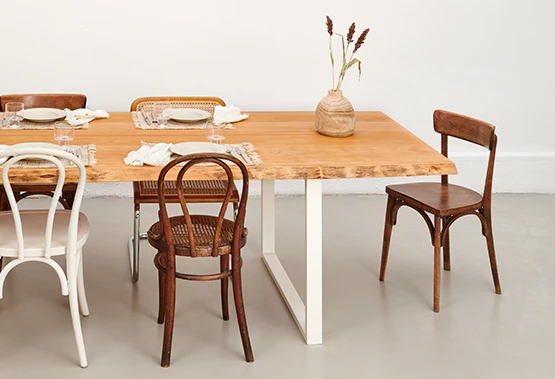
Which legs should you choose for your tabletop?
Choosing the table base is almost as important as choosing the tabletop: it ensures the table remains stable while also contributing to its overall style. Ilicut offers a range of table legs that can be combined with the tabletop, allowing you to create a table suited directly to your project.
Matching the table base to the tabletop
The legs should be chosen according to style and intended use, but also stability: widely spaced support points require a thicker tabletop. Choosing the tabletop and legs at the same time creates a coherent set that is ready to assemble.
In summary
The best option depends on three main criteria: the intended use, the wood species and the dimensions. For a main dining table, one of the most reliable combinations is solid oak, a thickness of 40 mm and dimensions calculated according to the number of guests. A custom-made tabletop remains the safest way to obtain a durable surface perfectly adapted to the room, without compromising on appearance.
You can start designing your project now using the custom-made tabletop configurator. For a custom shape or complex cut-out, Ilicut's design office can assist you.