
Published on 22/04/2026 in the Decor Ideas section
Decor & Inspiration - Entryway design guide
The entryway. A space you walk through ten times a day without really noticing it. And yet, it sets the tone for your entire home: the first and last impression. Too small, too dark, cluttered with shoes and coats, it is often the most overlooked area in interior design.
What if you changed that? With the right ideas and the right materials, even a two-square-metre hallway can become a space that feels both welcoming and practical.
Why optimizing your entryway is essential
Your entryway is not just a neutral transition space. It is the first thing you see when you come home, and the first thing your guests notice about the way you live. A well-designed entryway changes everything, starting with your mood first thing in the morning.
01
First impressions always matter
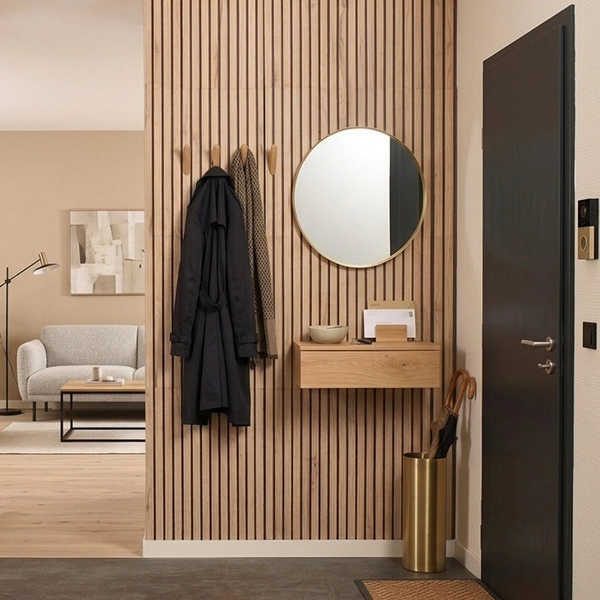
A cluttered hallway, an overloaded coat rack, shoes piling up everywhere… the entryway quickly loses its appeal and feels neither inviting nor pleasant to linger in. On the other hand, a well-organized entryway enhanced with a few decorative touches such as a mirror, a minimalist shelf, or a plant immediately creates a warm and welcoming atmosphere. Often overlooked, the entryway deserves just as much attention as the kitchen or bedroom, because it sets the tone for the entire home.
02
A strategic storage area
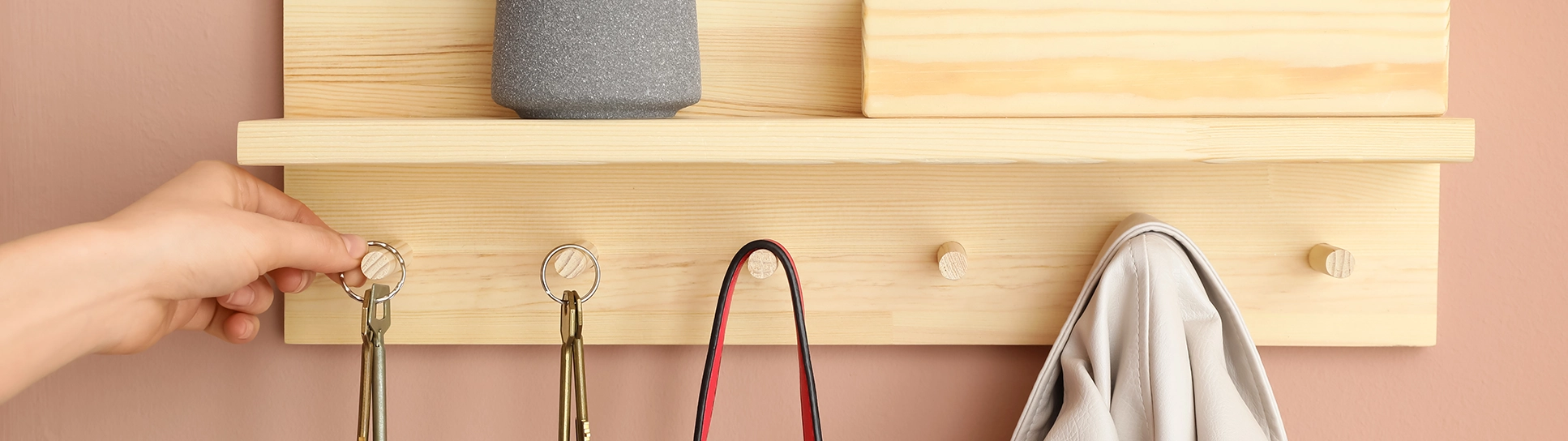
By nature, the entryway is where everyday essentials pass through: coats, bags, keys, mail, shoes. If no storage is planned, these items end up on the floor, on chair arms, anywhere except where they should be. A custom entryway unit, a bench with built-in storage, or a few well-placed hooks can be enough to solve the problem while also expressing your style.
03
A space-saving solution that changes daily life
In most homes, the entryway is small. And yet, this constraint can become a real asset when properly designed. By using height, making smart use of the walls, and taking advantage of every centimetre, it is possible to create a space that is both functional and attractive. A well-optimized entryway often feels more harmonious and pleasant to live with than a large but poorly structured space.
The 3 fundamental rules for designing an entryway
Before thinking about decor ideas, here are a few simple principles to keep in mind before getting started.
01
Maximize vertical storage
In an entryway, floor space is often limited while the walls remain underused. Making use of height is an easy way to optimize the layout with shelves, hooks, or a full-height unit. A solid wood panel fixed from floor to ceiling can significantly increase storage without getting in the way of movement.
02
Visually define the space
In open-plan apartments or homes without a separate hallway, the entryway does not naturally exist: it has to be created. A wooden claustra, a well-positioned shoe cabinet, or a change in flooring is enough to show that you are moving from one space to another.
03
Keep the flow smooth
In a small entryway, every detail matters. A unit that is too deep, a poorly positioned bench, or a badly oriented door can quickly get in the way. To avoid these issues, it is essential to keep at least 80 cm of clearance in front of each element and to choose shallow furniture, ideally between 25 and 35 cm deep.
8 decor ideas to optimize an entryway layout
01
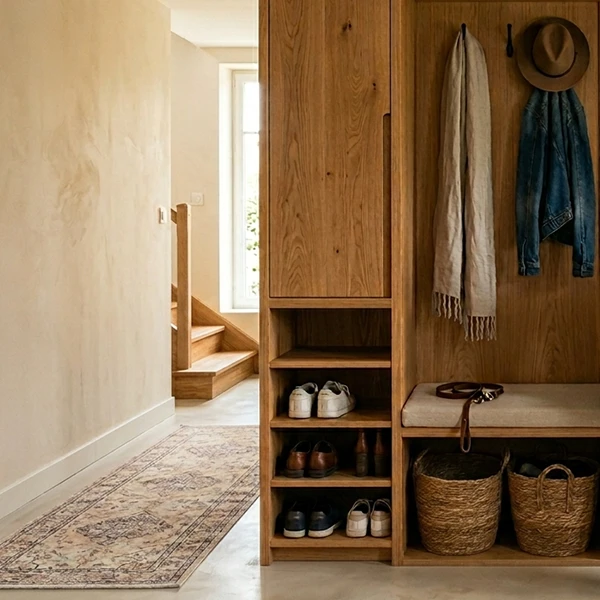
Install a custom-made entryway unit
This is the most complete solution. A unit designed for your space, with height, depth, and compartments tailored to your needs, will turn a chaotic entryway into a perfectly organized area. In solid wood, it will last for decades. And unlike off-the-shelf furniture, there will be no cuts to adjust and no wasted space.
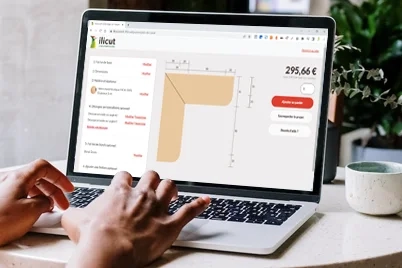
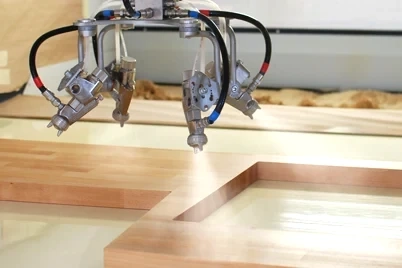
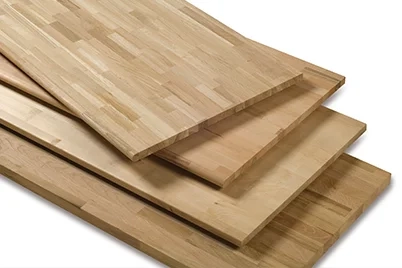
For a durable and attractive entryway unit, choose custom solid oak panels with a minimum thickness of 20 mm. Ask for an oiled factory finish so the wood arrives ready to install, nourished and protected, with no additional finishing work required. Use our online configurator to enter your exact dimensions.
02
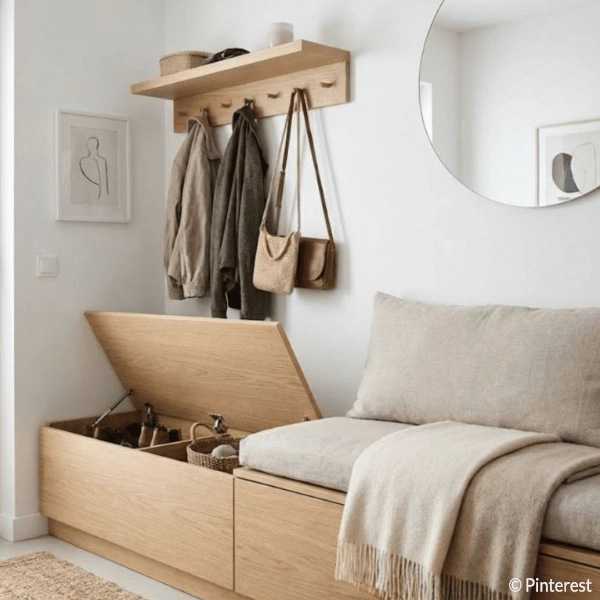
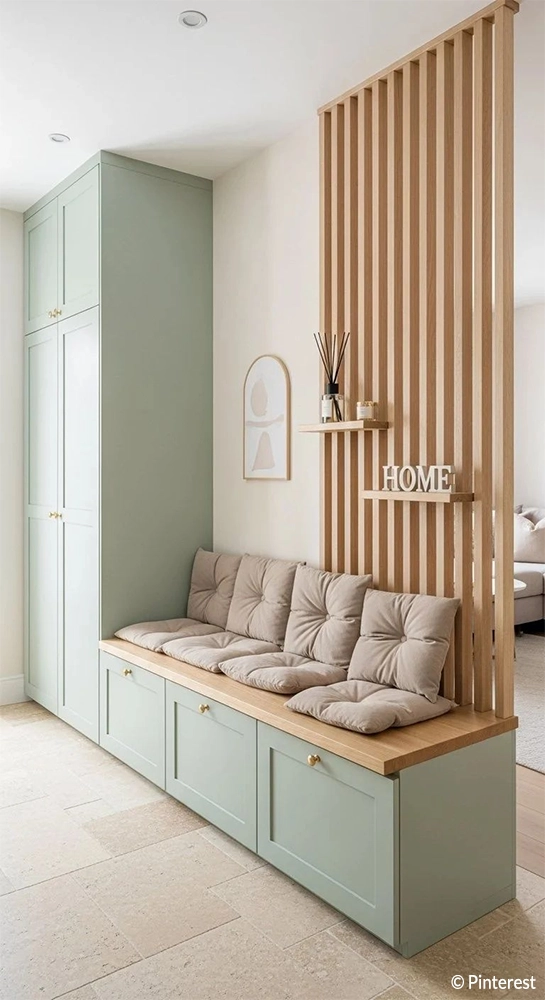
Create a bench with built-in storage
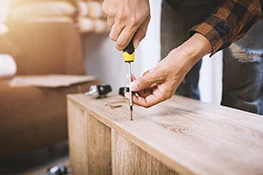
The entryway bench is one of the most popular DIY projects and one of the most useful. A solid wood top placed on two storage boxes, a few piano hinges to access the compartments, and the result is both functional and decorative. Add a cushion on top, and the entryway becomes a place where you sit down to tie your shoes, where children drop their bags, and where guests find a comfortable place to leave their belongings.
To design a solid wood bench, rubberwood is an excellent option thanks to its density, durability, and even grain, which takes stain easily. Plan for a top thickness of 30 to 40 mm to ensure long-term sturdiness, even with intensive daily use.
03
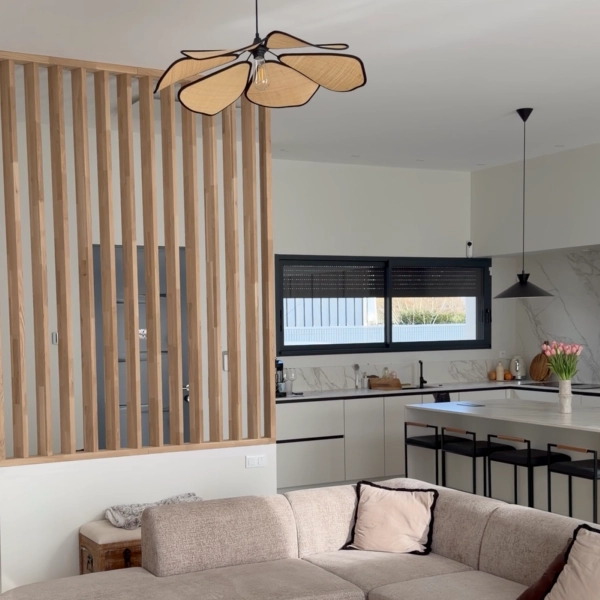
Add a wooden claustra to structure the space
In an entryway open to the living room or kitchen, a wooden claustra is both an architectural and decorative solution. It creates a visual boundary without closing off the space, lets light pass through, and creates beautiful plays of shadow and volume. In oak or ash, it dresses the wall with understated elegance.
The spacing between the slats of a claustra determines its visual effect. Narrow spacing (5 to 8 cm apart) creates a more defined separation, while wider spacing (12 to 15 cm apart) brings more transparency and lightness. Choose according to the level of privacy you want.
04
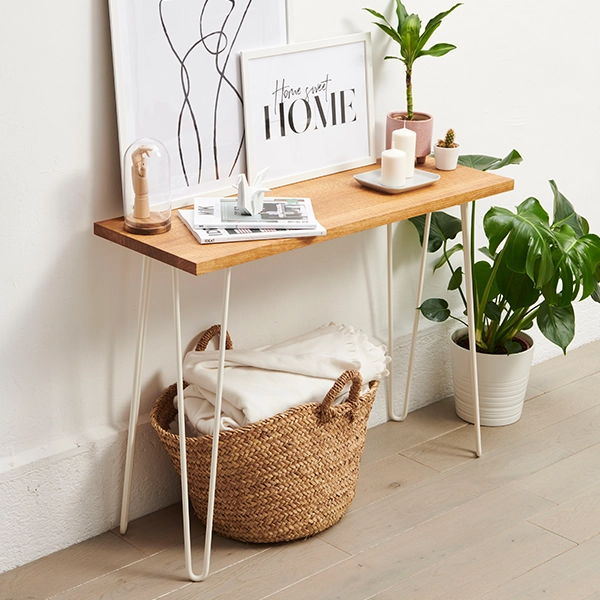
Use a slim wooden console table
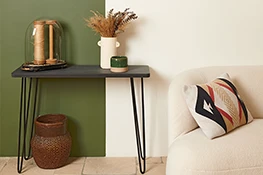
A narrow console table, with a solid wood top on black or white metal hairpin legs, is one of the simplest and most effective ways to style an entryway. It offers a practical place to leave keys, mail, or decorative objects, while staying compact at only 25 cm deep. It immediately gives the space a clear decorative identity.
05
Make use of the walls with shelves
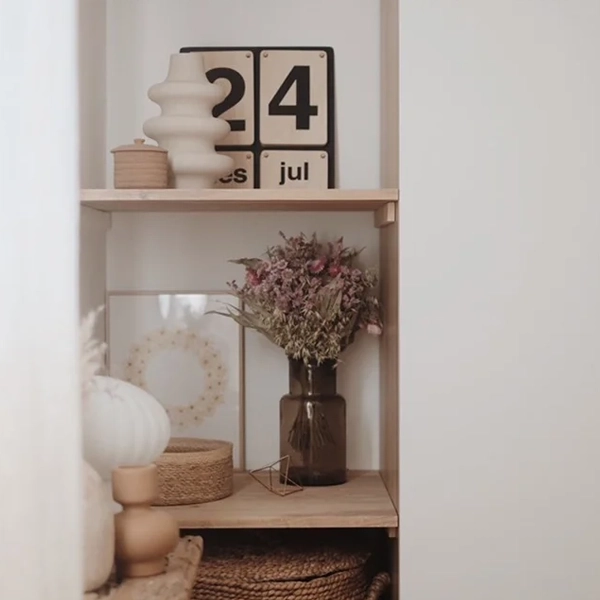
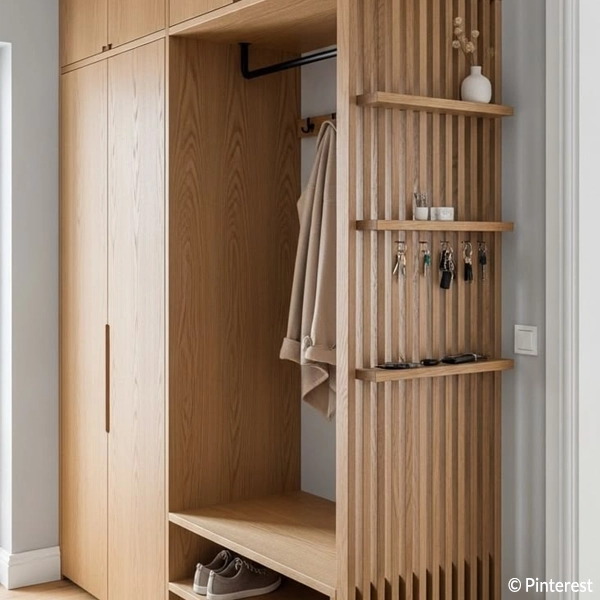
Solid wood wall shelves at different heights are the easiest way to add storage and decor without taking up floor space. Everyday items go on the lower shelves, while the upper part becomes a decorative composition. Shelves can go all the way to the ceiling to maximize storage capacity.
06
Create a compact entryway wardrobe
When space allows, such as in an alcove, under a staircase, or in a hallway nook, a compact wardrobe is the ultimate solution. It combines a hanging rail, shelves, and drawers to organize clothes and accessories discreetly and accessibly. The whole can be completed with a linen curtain or sliding doors for a finish that is both practical and harmonious.
07
Design the space under a staircase
The space under the stairs too often becomes a broom cupboard. That is a mistake: it is one of the most interesting volumes to design in a home. Custom storage boxes, sliding doors, joinery angles adjusted to the slope of the stringer: everything is possible with panels cut to the right dimensions.
Under-stair design is the ultimate custom project. Dimensions are always unusual, and angles are rarely square. Our design office can support you with complex projects, including remote measuring assistance. Be sure to match the tone of the wood used for your under-stair unit with that of your staircase treads.
For the best result, use the same wood species for your under-stair unit as the one used for the manufacture of your staircase treads.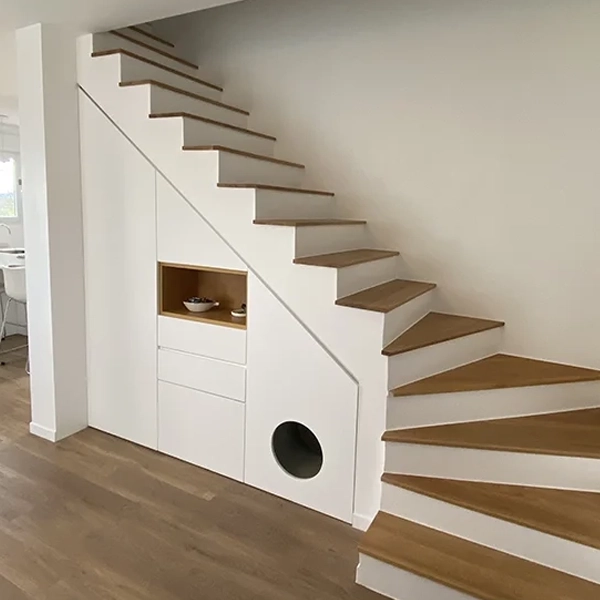

08
Use wooden wall panels
A wall covered with wooden panels, with horizontal or vertical slats, instantly transforms an ordinary entryway into a designer space. The contemporary wood panelling effect is highly appreciated in today’s interiors, and it is easy to achieve with decorative wall cladding cut to the right dimensions.
Which wood should you choose for your entryway?
The entryway is exposed to a few specific constraints: frequent traffic, seasonal moisture (wet coats, muddy shoes), and occasional knocks. So choosing the right wood is not something to overlook.
Oak: robust and timeless
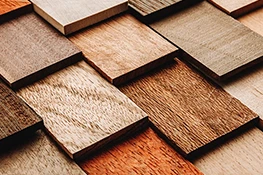
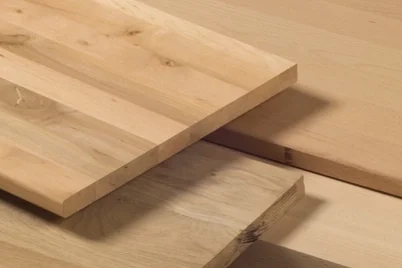
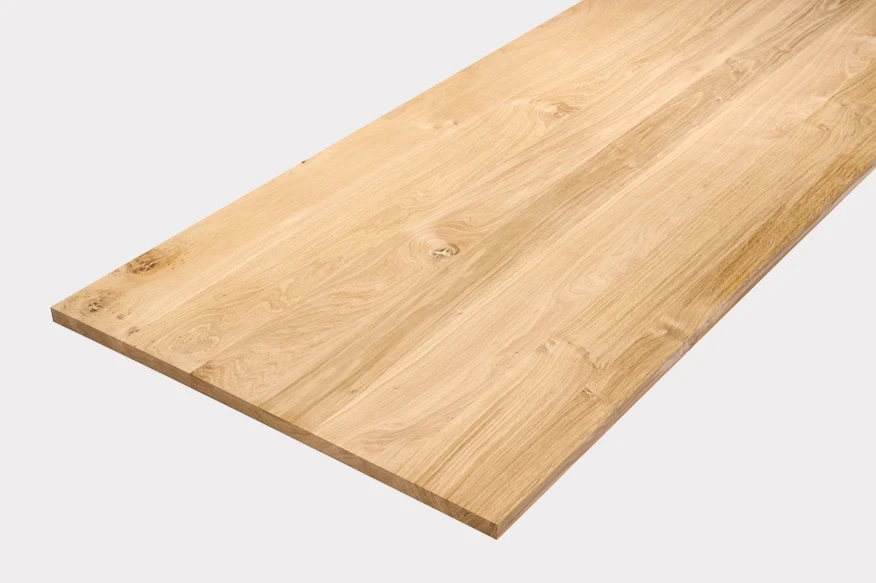
Timeless and elegant, oak is a safe bet for designing an entryway. Its density and resistance to impact as well as moderate moisture make it a durable choice. Its noble grain, which develops a beautiful patina over time, along with its naturally warm tone, immediately brings character and charm to the space.
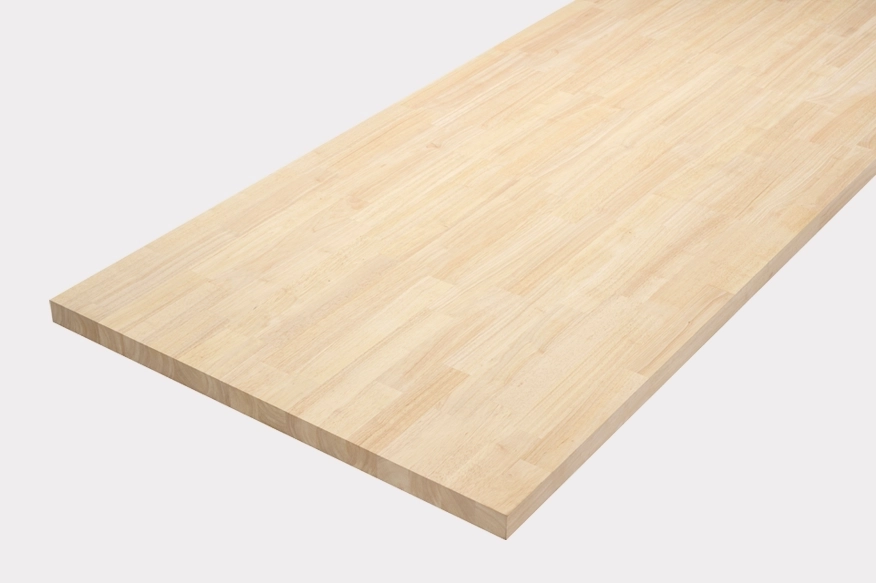
Rubberwood: excellent value for money
Sourced from the rubber tree, rubberwood is a dense, even-grained species that is easy to work with and takes stains and oils very well. It is significantly more affordable than oak while offering very similar performance. Ideal for DIY projects and controlled budgets.
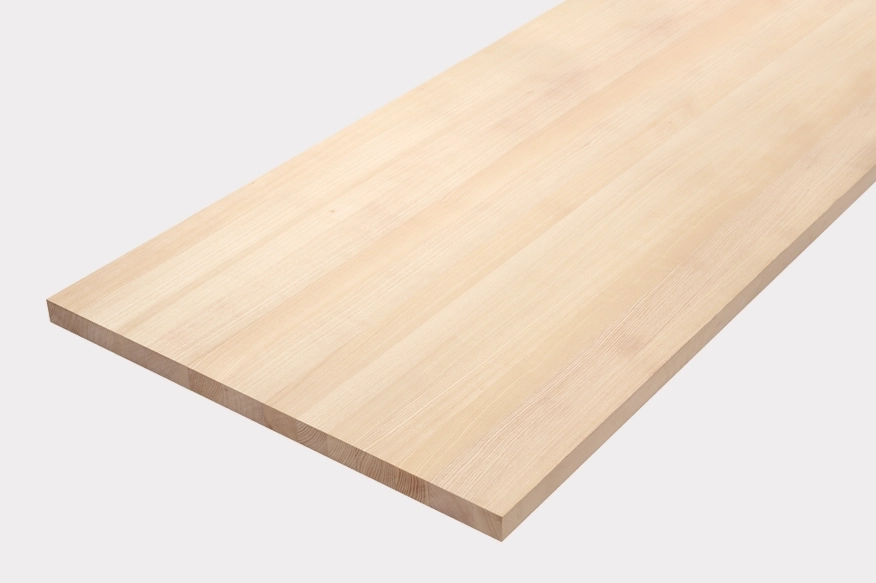
Ash: modern and bright
Lighter than oak, with more pronounced grain and a tone close to ivory white, ash is the perfect ally for contemporary interiors and Scandinavian-inspired spaces. It brings light into dark entryways and pairs beautifully with metal and white finishes.
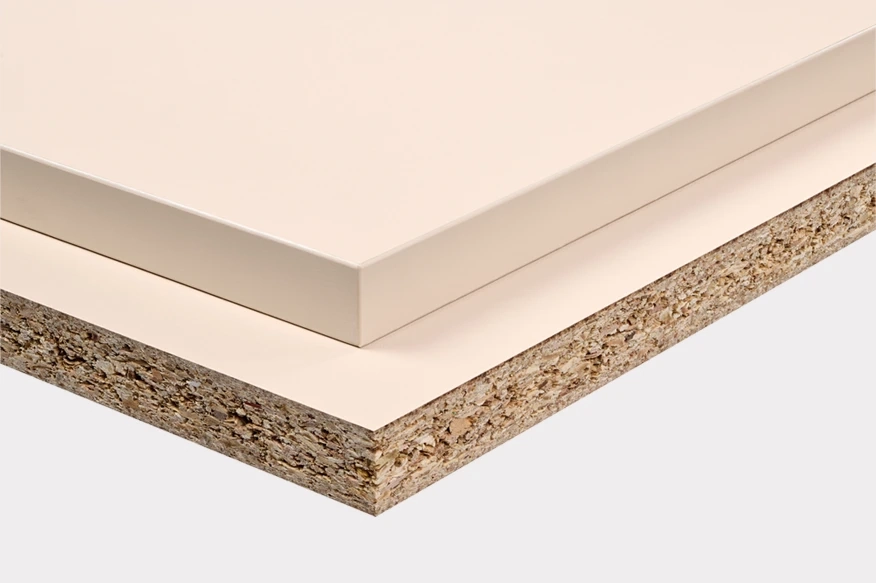
Melamine: the alternative to solid wood
Melamine is an ideal solution for fitting out an entryway in a practical and budget-friendly way. Its surface resists scratches, stains, and everyday moisture well, making it suitable for high-traffic areas. Available in a range of colours, it allows you to create furniture that is attractive and consistent with all interior styles.
Ilicut workshop tips
Finishes: For an entryway, we systematically recommend an oil finish rather than varnish. Oil nourishes the wood deeply, makes it slightly water-repellent, and is easy to repair (a dab of oil on a scratch is enough to make it disappear). Varnish creates a surface film that protects better but scratches more visibly and is harder to repair.
Moisture resistance: No solid wood is naturally waterproof, but all can be made resistant to moderate moisture with the right finish. Hardwax oil or tinted hardwax oil (to be renewed every 2 to 3 years) is the most effective solution for an entryway. Avoid letting water sit on the surface.
Daily care: A dry or slightly damp cloth is enough for everyday maintenance. Once a year, an application of maintenance oil revives the colours and reinforces protection. That is all it takes for a solid wood piece of furniture to last for decades.
How to optimize a small entryway
A small entryway (less than 4 m²) is the most common layout, especially in apartments. Here is how to approach it.
Mistakes to avoid
- Choosing furniture that is too deep (more than 35 cm)
- Installing hinged doors that block movement
- Using too many decorative objects that make the space feel cluttered
- Neglecting lighting and leaving the entryway in semi-darkness
Space-saving solutions
- Shallow furniture (25 to 30 cm)
- Vertical storage up to the ceiling
- Sliding or flap doors
- A large mirror to visually enlarge the space
- Light-coloured walls
- Soft, diffused lighting
Ilicut tip
In a small entryway, precision is key. Store-bought furniture will almost always be either too large or too small: it will be missing a few centimetres here or stick out a little too much there. With custom wooden panels cut to your exact dimensions, you make use of every centimetre. That is the difference between a piece that simply fits and one that integrates perfectly.
Your entryway deserves better. Get started now!
The entryway is the first room you see when you come home. It deserves real thought and careful execution. There is no shortage of ideas, and no shortage of solutions either. What often makes the difference between a beautiful entryway and an ordinary one is the precision of the furniture, the quality of the materials, and how well everything is adapted to the real constraints of your space.
That is exactly what custom-made design makes possible. Not a piece of furniture that comes close to your needs: one that meets them exactly.
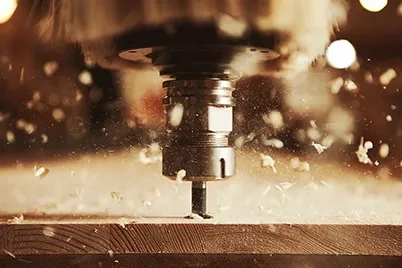
Oak, rubberwood, ash, melamine: whatever your preferred material and budget, Ilicut cuts, prepares, and delivers your panels ready to assemble, to the exact dimensions you have chosen.
Frequently asked questions
How do you design a small entryway?
Choose shallow furniture (25 to 30 cm), vertical storage, sliding or flap doors, a large mirror, and soft diffused lighting. Custom-made furniture makes it possible to use every available centimetre.
How deep should an entryway unit be?
Between 25 and 35 cm for a shoe cabinet or console table. Beyond that, the piece usually gets in the way in most entryways. Custom-made design allows you to adapt that depth down to the millimetre.
What furniture should you choose for an entryway?
Depending on your space: a bench with built-in storage if you have enough width, a slim console table if the space is very limited, or a custom column unit if you want to maximize vertical storage.
How do you create storage in an entryway?
Go upwards: wall shelves, vertical hooks, a unit up to the ceiling. Use hidden spaces: storage under a bench, compartments behind flap doors, space under a staircase.
Which wood should you choose for an entryway unit?
Oak for strength and a premium finish, rubberwood for excellent value for money, ash for a contemporary and bright look. In every case, an oil finish is recommended to protect the wood from the moderate moisture typically found in an entryway.