

Why choose a laminated panel for your fittings?
The laminated panel stands out for its robustness against everyday constraints. Its surface resists stains, impacts, heat and moisture. These properties make it a material particularly suitable for wet rooms and spaces subject to intensive use.
The laminate sheet, applied seamlessly without breaks or joints onto the particleboard core, creates a homogeneous and easy-to-maintain surface. A simple wipe with a sponge is enough to preserve its original appearance. This ease of use represents a considerable advantage for families and anyone looking for practical solutions.
The value for money of laminate is also a major asset. This material offers long-lasting performance with a controlled investment, making it possible to design functional kitchen worktops without compromising on quality. The ilicut advice
For a professional finish, opt for edge banding. This service, carried out in our workshop, guarantees perfect visual continuity and provides long-lasting protection for the edges of your custom-made panels.
What are the recommended uses for a laminated panel?
The laminated panel excels in applications requiring durability and easy maintenance. Kitchens are its preferred environment: worktops, splashbacks, and central island tops. Heat resistance allows hot dishes to be placed without risk, while the non-porous surface prevents liquids and grease from penetrating.
In bathrooms, laminated panels are ideal for vanity units, wall shelves and storage. Their resistance to constant humidity prevents swelling and warping, common issues with other wood-based materials.
Other applications include:
- occasional furniture: tables, desks, shelves;
- wardrobe and dressing room fittings;
- worktops for laundry rooms and technical spaces.
The versatility of laminated panels makes it possible to create visual consistency between different rooms while benefiting from a uniformly resistant surface.
How to choose your laminated panel according to your project?
Choosing a laminated panel mainly depends on its final use and the environment in which it will be installed. The 4 decors available in our range – cupria slate, chicago concrete, halifax oak and crystal marble – have been selected for their timeless character and their ability to blend with a wide variety of interior styles.
- For a kitchen worktop, choose natural-looking decors that stand the test of time: understated finishes integrate seamlessly into all interior styles.
- For a bathroom, light tones bring brightness and a sense of space, two qualities particularly sought after in wet rooms.
Another criterion is panel thickness, which affects rigidity and unsupported span. For large worktops or shelves bearing heavy loads, greater thickness ensures long-term stability. Edge banding completes both the aesthetic and functional aspects. This finish protects the panel edges and delivers a professional result comparable to the work of skilled craftsmen. You can choose which edges to band according to your needs and the desired visual effect.
ilicut custom cutting for your laminated panels
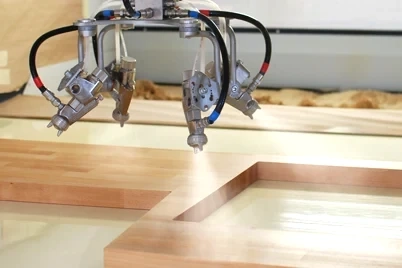
Ordering a custom-made laminated panel from ilicut simplifies the execution of your fitting projects. Our workshop carries out cutting and machining according to your exact dimensions, and each laminated board is carefully prepared. You receive components ready to install, significantly reducing the time required to complete your project.
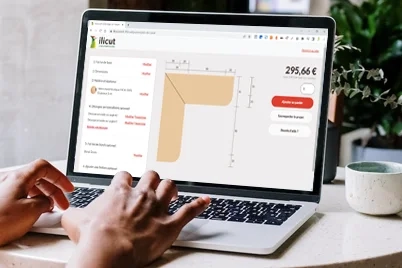
The online ordering process takes place in just a few simple steps. You define the shape, specific cut-outs and dimensions, select the decor from our range, and choose machining and finishing options. Home delivery is then arranged throughout France.
This approach aligns with our eco-responsible commitments: precise cutting limits material waste, and our optimized processes reduce the environmental footprint of each order. You benefit from a complete service, from design to delivery, without having to visit a physical store.